Strategies, mindset shifts, and tools for those who want to leave the past behind.
Discover systems to help you grow, habits to fuel inspiration, and ways to become empowered that bring back the spark that you once had.

Discover systems to help you grow, habits to fuel inspiration, and ways to become empowered that bring back the spark that you once had.
Everyone’s journey is different, but the challenges are surprisingly similar. Self-doubt, unfinished projects, and the struggle to make things sustainable. The Power2Live™ Trauma-Informed Coaching Program is all about you. The program provides you with the mindset and systems to navigate those hurdles and find your way home.

Fuel your inspiration
Discover rituals and practices that keep purpose alive day after day.

Overcome the messy middle
Tools for navigating self-doubt, low self-esteem, and growth beyond the trauma.

Grow on your own terms
Build resilience, community, and self-confidence by finding your voice and speaking your truth.
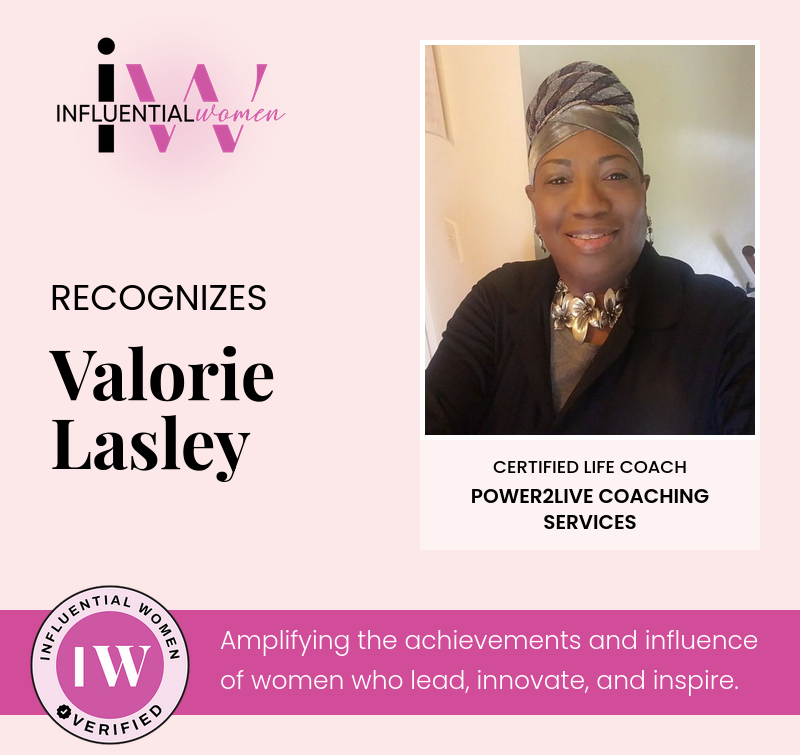
My name is Valorie H. Lasley, and my life’s journey is a testimony that freedom is not just a hope—it’s a decision. I lived for years believing I was forgotten, that my pain had the final word. At eight years old, I experienced a trauma no child should face, and that wound opened a door to cycles of abuse that followed me well into adulthood. For sixteen years, I survived in silence within an abusive marriage that tried to erase my identity, worth, and voice.
But something shifted.
One day, I realized that if I was going to fight for anything—it would be *me*. My freedom, my healing, my peace. That awakening wasn’t just about breaking free from abuse; it was about rising into a life of *deliberate wholeness*. That’s what the Power2Live™ Trauma-Informed Coaching Program is all about.
This program is the result of my fight to reclaim my life. It’s rooted in my belief that your past doesn’t have to define your future—it can *refine* it. Through spiritual growth, personal development, and practical tools, I’ve created a space for women like us to rise—bravely, boldly, and beautifully.
Here’s how the program has helped others stay inspired, finish what they started, and grow into wholeness.
★★★★★
Coach Valorie shows up every time as her authentic self. She leads with integrity and strength. Her listening skills are spot on.
Ravone
★★★★★
I didn’t realize what was holding me back. Once I understood that forgiveness is a major component of healing, I began to feel renewed.
Shirley
★★★★★
Coach Valorie is not afraid to speak her truth. Meeting her felt good and genuine. She listens with her heart and that made it easier for me to share below the surface.
D’lana
Healing the Invisible Wounds: A Reflection on Childhood Trauma and Its Echoes in Adulthood
Good evening.
Today, I want to speak to the hearts that carry silent stories—the ones shaped by childhood trauma. These experiences, often buried beneath layers of survival, don’t simply vanish with age. They echo. They shape how we love, how we trust, how we see ourselves.
Childhood trauma isn’t just about what happened. It’s about what was lost: safety, innocence, connection. And as we grow, we may find ourselves navigating adulthood with tools forged in chaos—hypervigilance, self-doubt, emotional withdrawal. These aren’t flaws. They’re adaptations. Proof that we did what we had to do to survive.
But survival isn’t the same as healing.
Healing asks us to revisit the places we’ve avoided. To name the pain. To understand that our triggers aren’t signs of weakness—they’re signals from a younger self still waiting to be heard. It’s in this listening that transformation begins.
We may struggle with intimacy, with boundaries, with self-worth. But these struggles don’t define us. What defines us is our courage to confront them. To rewrite the narrative. To say: “I am more than what happened to me.”
And for those who feel left behind—who carry grief for the childhood they never got to live—I want you to know: you are not alone. There is no expiration date on healing. No shame in seeking help. No weakness in vulnerability.
Let us be gentle with ourselves. Let us honor the resilience it took to get here. And let us believe, even if just a little, that healing is possible—not because the past changes, but because we do.
Thank you.
Contact Information
power2livecoachingservices@outlook.com
Instagram @valorielasley
Facebook- Valorie H Lasley
TikTok- @lasleyv
ADVERSE CHILDHOOD EXPERIENCES
How do you think childhood trauma shapes the way someone sees themselves- and how might that impact their relationships later in life?
Freedom Friday
The Courage to Heal Out Loud: Post 4

Coming to terms with the fact that my mother is a narcissist was one of the hardest truths I’ve ever had to face. Narcissistic mothers see their children as extensions of themselves, not as individuals. They control, manipulate, and shame, leaving their children to grow up doubting their worth, their instincts, and even their identity. Once my eyes opened to that reality, they didn’t close again.
Anyone who knows me knows how much I love Black history, so being accepted into Central High School—Louisville’s historic Black high school—felt like a dream. After two years in private school, I was ready to grow. My father supported me fully. My mother, however, did not. She wanted me to stay in private school or switch to online school, without any real reason. The only way she agreed to let me attend Central was by placing a stipulation: I had to pray Dhuhr in the counselor’s office every single day, and if she ever called and they didn’t confirm it, she would pull me out.
Despite wearing hijab for the first time in public school, I adjusted quickly. I went to all my classes, earned A’s and B’s, joined beginner band, and built genuine friendships with people who liked me for who I was. I spent my free time in the library reading. I wasn’t focused on boys; I was focused on my grades and enjoying my friends. I took pride in being part of the Yellowjackets Class of 2014.
During my time at Central I had the courage to stand up for another hijabi who was being bullied to remove her hijab. I also had an altercation with one of the star varsity basketball players and he tried to bully me. Despite his status in the school, I still stood up for myself in front of the whole class, which earned me respect from my peers. Gym class was the hardest. Every day in the locker room a group of girls surrounded me and tried to pressure me into taking off my hijab. I always refused. One day after gym class, I discovered my school hijab had been stolen from my bag. I knew someone had taken it so they could see my hair whenever I went to change back into my school clothes, but I simply wore my gym hijab for the rest of the day. When my mom noticed that hijab was missing, I was scared to tell her. I explained the bullying that I had experienced and that the girls must have stolen it, but she didn’t believe me. She insisted that I must have taken it off to flirt with boys. My time at Central wasn’t perfect, but those experiences taught me how to navigate conflict.
Every day after school my mom asked about my day, but it was never genuine. She always followed up with, “What boys do you like? Do you have a boyfriend? God will expose you if you’re lying.” She wasn’t interested in my accomplishments or struggles previously mentioned. She never failed to tell me daily that I had “dark energy” and that I was changing because I wasn’t in private school anymore. Now I realize she was panicking because she saw me discovering myself, my personality, and my independence.
One day I begged my mom to let me stay after school with my bandmates before our recital. She said no, but my dad said yes. That afternoon was one of the best moments of my life. Me and my friends walked to Indi’s and Wendy’s, ate, laughed, and just enjoyed being kids. On the way back, we crossed a field full of pollen. My eyes started itching, and by the time I got home, they were swollen shut. My mom immediately assumed I had been in a fight. When I told her I hadn’t, she accused me of “rolling in the grass with a boy” and said God exposed me. I’m allergic to grass, so that was impossible, but she believed it wholeheartedly.
The next day she called the school to check on my prayer routine. They told her they hadn’t seen me in a while. After that call, she pulled me out of Central without asking why or caring about the real reason. Her stipulation was broken, and that was all she needed. The truth was that slipping out of class to pray became difficult. The anxiety of waiting for someone to open the classroom door afterward was overwhelming and most times they would purposely take too long.
Just like that, I was back home for the last two weeks of freshman year. I didn’t get to say goodbye to my friends. It came off as if I ghosted everyone. My grades were excellent, my teachers loved me, and I wasn’t causing trouble. I was simply a daughter whose mother couldn’t handle watching her blossom.
I was enrolled in E‑School, doing my work alone while everyone else was at school or work. Ironically not too long after being pulled from Central, my eyes swelled up again. Only this time at home, with no boys, no grass, nothing. My mom looked at me and chuckled, “Oh, I guess you really weren’t rolling in the grass with a boy, huh?” No real apology. No re-enrollment. Just a shrug. This was an eye-opening moment for me.
I want to take the time out to thank all my Central folks for making my freshman year there memorable. I cherish those moments and don’t take that time for granted. Shantiara Miller Austin Hill Alston Hammond Ife Akindele De’Anjalique Monet Lamb Phillip Bradley Jr. Keenan Glenn and Donya Baker
After being pulled out of Central, pushed into E‑School, forced to graduate early, and married shortly after, my husband gave me the space to find myself again. He encouraged me to embrace who I was, and I slowly began to bloom.
Y’all remember when I wore bows? It was something unique to me that complimented my personality and it was a great conversation starter. Most people loved them, but more importantly I wore them because I loved them. Even Maryum Ali (Muhammad Ali’s eldest daughter), Attallah Shabazz (Malcolm X’s eldest daughter), and Angela Davis liked my bows. But my mother hated them. She never missed a chance to say so.
One night at an all-women’s dinner party, the host, who was going through her own struggles at the time, targeted me. She said I looked “mentally retarded” with the bows, and my mom nodded in agreement. My mom added her own insults and said that I was making a mockery of religion. She even tried to pull another person into the bullying and they declined, thank God. My eyes filled with tears, my heart was pounding, and I sat there listening to two grown women tear me apart. One of them being my mother. I was in disbelief. Afterwards, I told my mom that my feelings were hurt from what had just transpired. She apologized, but it wasn’t genuine. I saw the joy in her eyes when she and the host bullied me for about 20 minutes at that party.
When I told my husband what happened, he was furious. He told me, “There’s nothing more important than you being you. Don’t let anyone take that from you.” At the time, I didn’t fully understand. I was discouraged, and eventually the bows disappeared into the closet. But his words planted a seed that is blossoming now.
Realizing that my mother used religion as a tool for control was devastating. Religious trauma is real. It doesn’t matter how modest you dress, how often you pray, how many times you go to Umrah or Hajj—if you use religion to control, shame, or belittle others, you are the lowest of the low.
Islam does talk about respecting and honoring your parents. But parents tend to forget that in Islam there is ALWAYS a balance. If children are to respect their parents, parents are required to treat their children right as well. Parents don’t own their children, God does. God loaned us his creation (children) and with that loan, we are supposed to handle it with love and care.


